For journalists
Data and charts for reporting on AI and pirated books
Which books were in the pirate libraries named in the AI copyright cases, when each library listed them, and what the court record says about each download. Every claim is graded by its source.
The data at a glance
Every report names each file by the library’s own ID, with the MD5 fingerprint of its exact bytes and the torrent and piece that carried it where the catalog and the archived torrents record them: what that means. Sources and dates for every figure are on the Methodology page. Catalog metadata only: we hold no book files.
Testing the site? How to test PayAuthors lists checks with answers you can verify, how we measure accuracy, and answers to the questions reporters ask.
How we grade what we say
Please keep the grade when you quote us: an allegation reported as a finding is the most common error in coverage of these cases.
Embed a chart
Each chart stays current and carries its credit line. Pick one, check the preview, and paste the code into your article. Images (PNG or SVG) and CSV downloads are in the Export menu under every chart on the site.
The last line is an optional script that sizes the frame to the chart, so nothing is cut off on phones. If your site strips scripts, leave it out; the frame keeps the height written in the code. Charts embed in the light style; add &theme=dark to the address for the dark one.
Get your outlet's press code
Enter your work e-mail and we will send a code named for your outlet, good for 10 free Registration Details reports: every catalog record under an author's name, with the library's own file ID, and the file's MD5 fingerprint and the torrent and torrent pieces that carried it where they are recorded; the full Copyright Office record for each registration; and whether it was registered before each documented download. Everyone at your outlet shares the same 10. The code goes only to your inbox.
Before you write: our white paper explains the collections, what the court record says each company downloaded, and what a match can and cannot show.
How to cite
Source: PayAuthors.com analysis of dated LibGen, Z-Library and Books3 catalog records, the Internet Archive’s lending-library catalog, and U.S. Copyright Office registrations (payauthors.com).
Charts, figures and tables may be shared unaltered with this credit and a link (reuse terms). For anything else, including data sets, bulk lookups or translations of our charts, ask us below.
Press kit
ZIP, about 6 MB. Documents: the white paper, the law-firm overview, and the sample Registration Details report as PDF, spreadsheet (CSV), data (JSON) and notes. Exports: every chart and table on our main pages as the Export menu makes them (SVG and CSV). Images: the ten charts above in light and dark, the wordmark and the open-book mark (SVG and PNG), cover images for Mastodon, X, Bluesky, LinkedIn and Facebook, and the link-preview cards. A short fact sheet carries the credit line. Every file carries the date it was made; the kit is rebuilt when our data, charts or documents change. For figures that stay current, use the live embeds above.



About PayAuthors. PayAuthors is a litigation support service that checks authors' names and ISBNs against dated copies of the pirate-library catalogs named in the AI copyright cases (LibGen, Z-Library and the Books3 file list), and the Internet Archive’s lending-library catalog, which is a nonprofit library, not a pirate site, and matches each book to candidate U.S. Copyright Office registrations to confirm against the Office record. It uses catalog metadata only and holds no book files. Reports are litigation support, not legal advice.
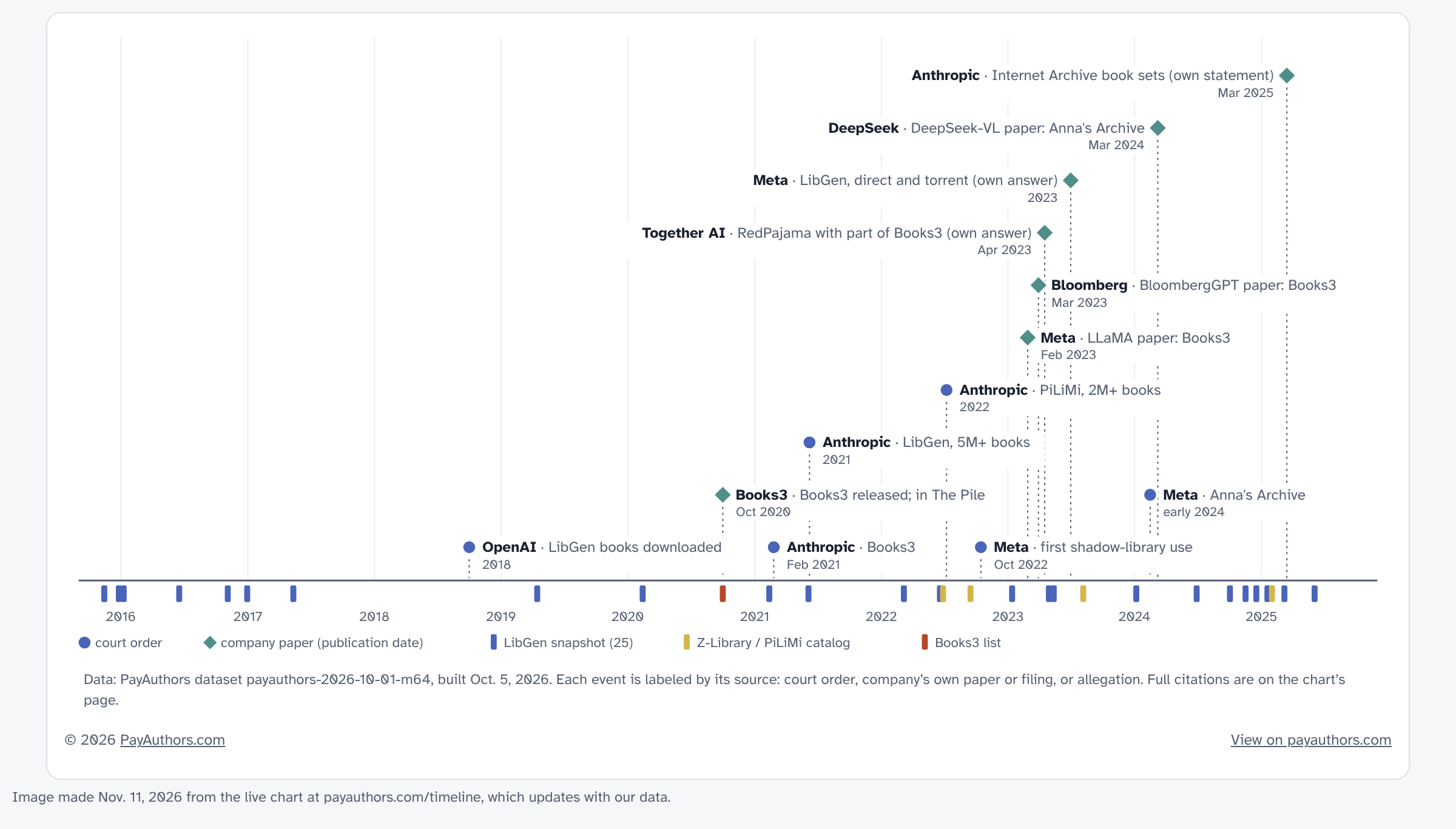
Background: the white paper · the lawsuits, company by company · timeline · latest rulings and filings · what a match shows · how to test us · methodology.
Ask about licensing, or a press code without a work e-mail
We reply by e-mail, usually within one business day. Press codes are for reporting and are free.